Google DeepMind launches Humanity's First Exam on Kaggle: top AI models ace easy tasks once but stumble on doing it every time
Google DeepMind's new HFE benchmark tests 544 simple text and image tasks for consistency. Top models score 96-98% on a single try but only 80.5-92.4% when they must get every variant right every time, with GPT-6.2 Astra leading and Gemini 4 Neon third.
The story in 30 seconds
- Google DeepMind launched Humanity's First Exam (HFE) on Kaggle on November 24, 2026: 544 simple text and image prompts in 136 four-prompt families.
- HFE scores reliability: a family counts only if a model answers all four variants correctly on four attempts each.
- In Google's report the top five models score 96-98% on a single try but 80.5-92.4% on the strict reliability metric; GPT-6.2 Astra leads at 92.4% and Gemini 4 Neon is third at 85.8%.
- About 73% of wrong answers come from visual perception, where extra reasoning helps much less than on maths and text.
- A Kaggle competition for new hard-but-simple questions runs until December 15, 2026.
- Answers were graded by a Gemini 3.1 Pro autorater; the authors flag possible same-provider bias and results are not yet independently replicated.
Is this official? Official announcement
- Rumour
- Reported
- Confirmed
- Official
Official launch: announced by Google on its blog on November 24, 2026, with a DeepMind technical report we opened and read. All scores are Google's own measurements, graded by a Gemini model, and have not been independently replicated. Prize details for the Kaggle competition come from third-party reports only.
Event date: 24 Nov 2026
What happened
On November 24, 2026, Google DeepMind released Humanity's First Exam (HFE), a new benchmark hosted on Kaggle. Unlike most AI tests, which keep getting harder, HFE is deliberately easy: 544 elementary text and image prompts that ordinary people can answer, such as counting coffee mugs without steam or naming the colours of letters on a neon sign.
The question is not whether a model can answer them, but whether it answers them correctly every single time. In Google's announcement, DeepMind research scientist Oran Kelly writes that HFE "measures whether models can consistently solve tasks (and slight variations) every single time."
Alongside the benchmark, Google and Kaggle opened a three-week community competition, running until December 15, 2026, that asks the public to submit everyday questions current models still get wrong. Accepted ideas are meant to feed future versions of the exam.
The name plays on Humanity's Last Exam, the expert-level benchmark from the Center for AI Safety and Scale AI. HFE is a separate project and tests the opposite end of the scale.
How the test works
According to the technical report, which is signed by nine researchers from Google DeepMind, Google Cloud and Google Research:
- 544 prompts in 136 "families". Each family has a seed question plus three close variations, so a model cannot pass by getting lucky on one wording.
- 20 foundational capabilities, grouped into Math & Algorithmic, Reasoning & Language, Spatial & Positional, and Vision.
- Human check. Only families whose seed prompt was solved by at least 3 of 4 independent human raters were kept.
- Strict scoring. The headline metric, family pass^4, requires a model to answer all four variants correctly on four attempts each, which is 16 correct answers in a row.
- Mostly private. 112 prompts (28 families) are public on Kaggle under CC BY 4.0; the other 432 prompts (108 families) are held back to limit training contamination.
- No tools. Tests use single-turn answers, without external tools, custom system prompts or agent harnesses.
How the models scored
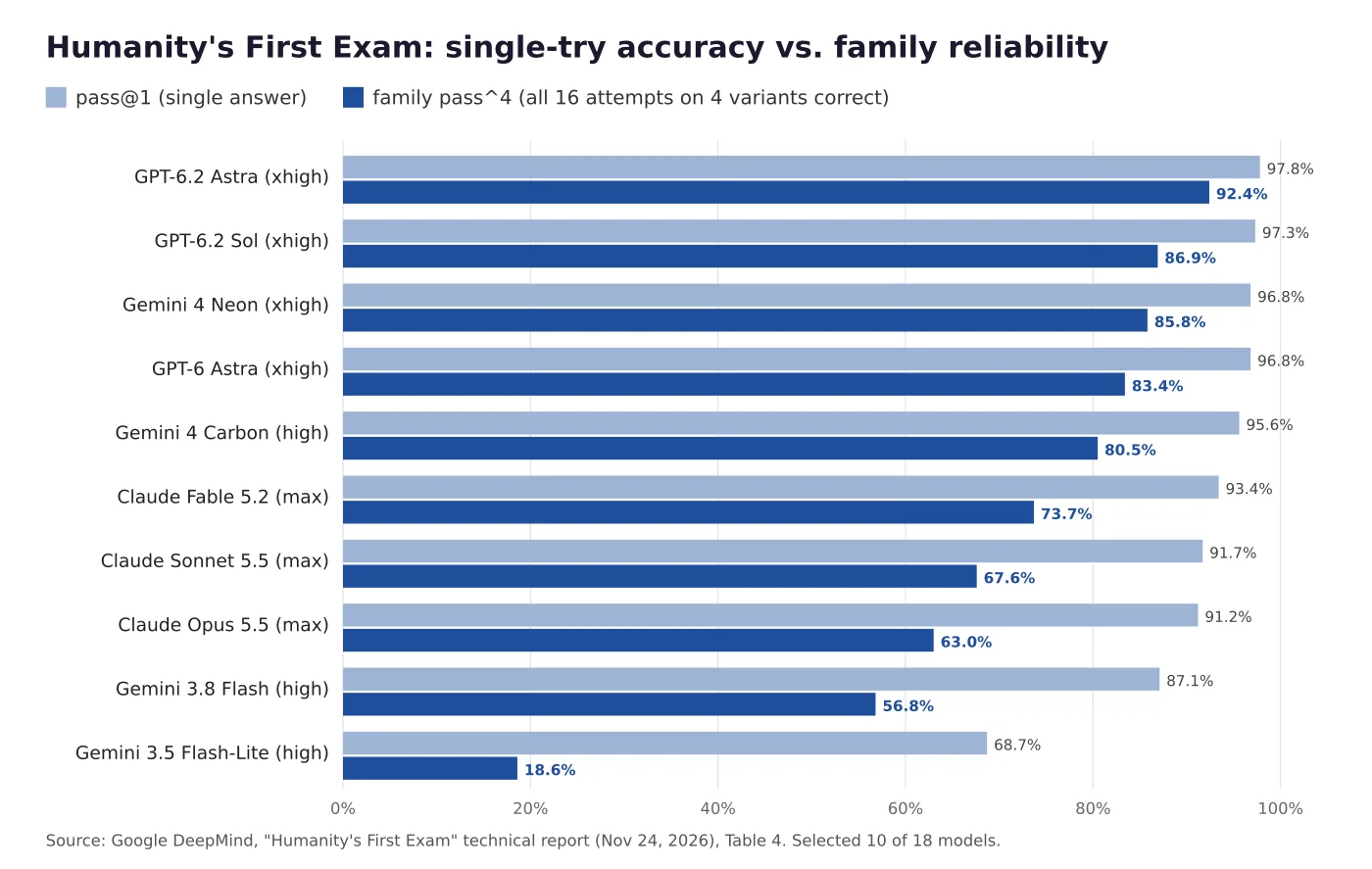
The report evaluates 18 models from Google, OpenAI and Anthropic. Almost all of them can solve nearly every family at least once, but far fewer can do it reliably. The top five reach 96% to 98% single-try accuracy (pass@1), yet only 80.5% to 92.4% on family pass^4.
| Rank | Model (reasoning effort) | pass@1 | family pass^4 |
|---|---|---|---|
| 1 | GPT-6.2 Astra (xhigh) | 97.8% | 92.4% |
| 2 | GPT-6.2 Sol (xhigh) | 97.3% | 86.9% |
| 3 | Gemini 4 Neon (xhigh) | 96.8% | 85.8% |
| 4 | GPT-6 Astra (xhigh) | 96.8% | 83.4% |
| 5 | Gemini 4 Carbon (high) | 95.6% | 80.5% |
| 9 | Claude Fable 5.2 (max) | 93.4% | 73.7% |
| 11 | Claude Sonnet 5.5 (max) | 91.7% | 67.6% |
| 12 | Claude Opus 5.5 (max) | 91.2% | 63.0% |
| 18 | Gemini 3.5 Flash-Lite (high) | 68.7% | 18.6% |
Source: Google DeepMind technical report, Table 4. These are Google's own measurements, not independent tests.
Across all 18 models, the gap between "solved at least once" and "solved every time" ranged from 7.6 to 80.1 percentage points. Google's best entry, Gemini 4 Neon, finished third, ahead of the larger Gemini 4 Carbon. The report says Anthropic's Claude scores were pulled down partly by safety refusals: refusals cut Claude Opus 5.5's family score by 4.4 points.
The live Kaggle leaderboard uses different settings from the paper. Third-party trackers BenchLM and AlphaSignal list it as GPT-6.2 Astra 90.7%, GPT-6.2 Sol 87.5% and Gemini 4 Neon 85.6%, which explains the slightly different numbers in some coverage. We could not open the Kaggle leaderboard page directly.
Where models fail
- Vision is the weak spot. About 73% of wrong answers involved visual perception, especially judging position, direction or paths (31%) and counting objects (23%). Google says these labels came from AI-assisted classification with manual spot checks, so they are approximate.
- More thinking helps text, not eyes. On Gemini 4 Carbon, lowering reasoning effort from high to low cut the Math & Algorithmic family score by 42.4 points but the Vision score by only 3.1 points.
- Humans and models struggle with different things. Human raters found logic and maths hardest; models found reading and counting things in images hardest.
The Kaggle competition
The competition invites anyone to submit simple questions that frontier models still get wrong, to keep the dataset fresh. Google's blog post gives the December 15 deadline but no prize details. AlphaSignal reports a $50,000 prize pool paid in Kaggle merchandise rather than cash, and says entries should be answerable by an attentive person within about two minutes. GCN's report describes the prize inconsistently, and we could not open the Kaggle competition page, so treat the prize details as reported, not confirmed.
Why it matters
Most leaderboards measure a model's best-case ability. HFE measures its floor: how often it fails at things a person would never get wrong. For businesses that want to automate routine work, a model that is right 97% of the time on a single try but only 85% of the time across a set of related checks can still break a workflow. The report also argues that raising this floor will need better visual perception, not just more test-time compute.
What we do not know yet
- Grading by Gemini. All answers were graded by a single Gemini 3.1 Pro autorater, and most images were generated by Gemini. The authors themselves name this as a possible source of "subtle same-provider bias", while noting that non-Google models scored highest on multimodal tasks.
- Chosen to trip models up. Prompts were picked because they caused failures in earlier models, so the scores are not everyday failure rates.
- Limited outside checking. Most prompts are private, and we found no independent replication of the results yet.
Related news
- Nov 18, 2026 – Google introduces Gemini 4 Neon: the mid-tier model that is Google's best performer on HFE, launched six days before the benchmark.
- Nov 17, 2026 – OpenAI releases GPT-6.2 Astra and GPT-6.2 Sol: the two models that top both the HFE paper and the live Kaggle leaderboard.
- Mar 17, 2026 – Google DeepMind proposes a cognitive framework for measuring progress toward AGI: an earlier DeepMind and Kaggle evaluation project, co-authored by HFE lead Oran Kelly, that also used a Kaggle hackathon.
- Jan 2025 – Humanity's Last Exam: the 2,500-question, graduate-level benchmark from the Center for AI Safety and Scale AI whose name HFE echoes.
Cover photo: Lewser / Wikimedia Commons, public domain (source).
Questions and answers
Is Humanity's First Exam official?
Yes. Google DeepMind announced it on the Google blog on November 24, 2026 and published a technical report the same day. The benchmark and its leaderboard are hosted on Kaggle, which is owned by Google.
Is HFE made by Gemini?
No. It was built by researchers at Google DeepMind, Google Cloud and Google Research. Gemini models are involved in two ways: most of the test images were generated with Gemini, and all answers were graded by a Gemini 3.1 Pro autorater. Gemini models are also among the 18 models tested.
How is HFE different from Humanity's Last Exam?
Humanity's Last Exam, from the Center for AI Safety and Scale AI, has 2,500 very hard, mostly graduate-level questions. HFE does the opposite: it uses simple everyday tasks that most people can solve and checks whether models get them right consistently, across repeated attempts and reworded variants.
Which AI model scored best on HFE?
In Google's technical report, OpenAI's GPT-6.2 Astra at xhigh reasoning effort led with 92.4% on the strict family pass^4 metric, followed by GPT-6.2 Sol (86.9%) and Google's Gemini 4 Neon (85.8%). The live Kaggle leaderboard, which uses different settings, is reported to show GPT-6.2 Astra at 90.7%. All of these are Google's own measurements.
Is Gemini 4 Neon better than Claude Opus 5.5 on this test?
On HFE as measured by Google, yes: Gemini 4 Neon scored 85.8% on family pass^4 against 63.0% for Claude Opus 5.5 at max effort. The report says safety refusals cost Claude Opus 5.5 about 4.4 points. This is one benchmark built and graded with Google tools, so it does not settle which model is better overall.
Why do top models fail such easy questions?
According to the report, about 73% of wrong answers came from visual perception problems, such as judging positions or paths and counting objects. Extra reasoning time helped a lot on maths and text tasks but much less on vision tasks.
How can I take part in the Kaggle competition?
Google and Kaggle are running a three-week competition until December 15, 2026, asking people to submit everyday questions that current models still get wrong. AlphaSignal reports the prize pool is $50,000 in Kaggle merchandise, not cash; Google's blog does not give prize details and we could not open the competition page to confirm.
Can I see the questions?
Partly. 112 prompts in 28 families are published on Kaggle under a CC BY 4.0 licence. The remaining 432 prompts are kept private so that models cannot be trained on them.
What are the limits of these results?
The prompts were selected because they made earlier models fail, so scores are not everyday failure rates. Grading used a single Gemini model, which the authors say could introduce subtle same-provider bias, and no independent replication has been published yet that we could find.
Sources
- We're launching Humanity's First Exam and a Kaggle hackathon to test LLM reliabilityGoogle24 Nov 2026Official Checked
- Humanity's First Exam: Measuring the Reliability Floor of LLMs (technical report)Google DeepMind24 Nov 2026Official Checked
- Google Humanity's First Exam AI Benchmark ExplainedTechRepublic27 Nov 2026 Checked
- Google DeepMind launches Humanity's First Exam to test AI reliabilityGCN27 Nov 2026 Checked
- Google DeepMind's HFE Catches Frontier AI Failing Basic Tasks at 85.6%AlphaSignal24 Nov 2026 Checked
- Humanity's First Exam (HFE) LeaderboardBenchLM24 Nov 2026 Checked
- Introducing Gemini 4 NeonGoogle18 Nov 2026 Checked
- Introducing GPT-6.2 Astra and SolOpenAI Checked
- Measuring progress toward AGI: A cognitive frameworkGoogle17 Mar 2026 Checked
- Humanity's Last ExamWikipedia Checked
Found this useful?
Send it to someone who follows this space.
This article was drafted with AI from the sources listed above and approved by an editor before publishing. Spotted a mistake? Tell us