
New OS-Omni benchmark finds top AI agents near human level on Linux but failing most iPhone tasks
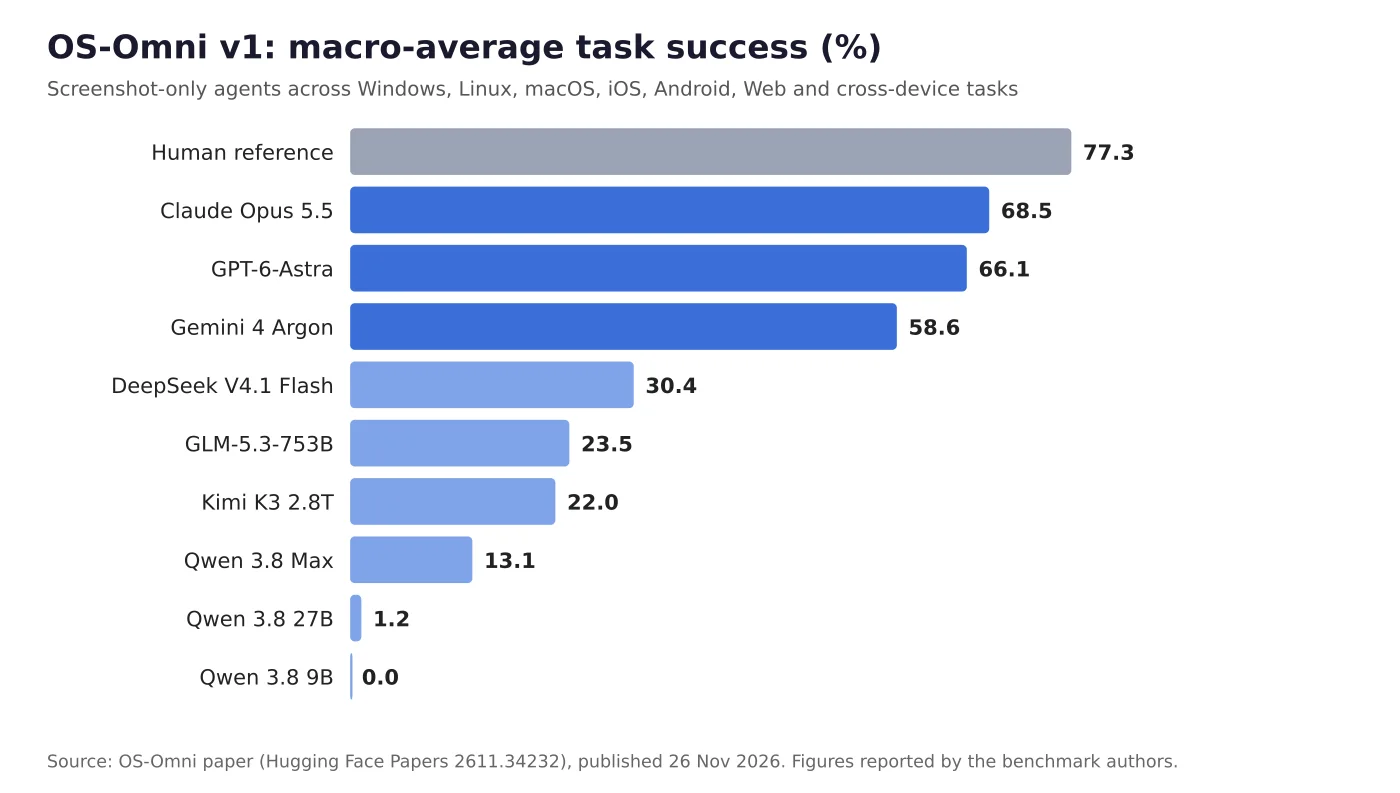
OS-Omni, a 300-task benchmark published on 26 November, tests computer-using agents on six platforms. Claude Opus 5.5 leads on average with 68.5%, against 77.3% for humans, while the best iOS score is just 41.7%.
The story in 30 seconds
- OS-Omni, published on 26 November 2026, has 300 tasks across Windows, Linux, macOS, iOS, Android, Web and 12 cross-device workflows.
- Claude Opus 5.5 has the best macro-average at 68.5%, ahead of GPT-6-Astra (66.1%) and Gemini 4 Argon (58.6%). The human reference is 77.3%.
- The top three models beat the human reference on Linux, but the best iOS score is only 41.7%, against 75.2% for people.
- Open-weight models trail far behind, with DeepSeek V4.1 Flash best among them at 30.4%.
- All scores are author-reported, and the code is not yet public.
Is this official? Official announcement
- Rumour
- Reported
- Confirmed
- Official
Published research: the benchmark and all scores come from the OS-Omni paper on Hugging Face Papers (26 November 2026) and the authors' project page, both opened. The scores are author-reported and have not been reproduced independently; the code is not yet public.
Event date: 26 Nov 2026
What happened
A large group of academic and industry researchers has published OS-Omni, a new benchmark that asks a single AI agent to finish long, multi-step jobs on six different computer platforms. The paper, "OS-Omni: Benchmarking Generalist Computer-Using Agents on Long-Horizon Workflows Across Platforms", appeared on Hugging Face Papers on 26 November 2026. The corresponding authors are Hui Shen (University of Michigan and Touchstone AI) and Qiushi Sun (University of Hong Kong). Contributors are listed from MIT, Princeton, Together AI, SGLang Omni and other groups. One OpenAI researcher says he took part in a personal capacity.
The tasks are long. According to the authors' human study, people needed about 67.5 interaction steps per task, against 15 for reference tasks in the older OSWorld benchmark.
The headline result: the best AI agents now come close to people on Linux and the web, but they still fall far short on Apple's iOS and macOS.
What is new
OS-Omni calls itself a "live cross-platform benchmark and execution environment". The v1 release has 300 tasks:
- 48 tasks each on Windows, Ubuntu Linux, macOS, iOS, Android and the Web (288 in total)
- 12 cross-device workflows that pair a desktop computer with an Android phone
The authors judge each task by the final state of the environment, such as whether a file, setting or app record ended up correct. They do not check intermediate screenshots. All seven models were tested with screenshot-only observation: the agent sees the screen as an image and acts on it, without reading the accessibility tree or other system data.
How the models scored
All figures below are task success rates reported by the benchmark authors. They have not been reproduced independently.
| Model | Windows | Linux | macOS | iOS | Android | Web | Cross-device | Macro-avg |
|---|---|---|---|---|---|---|---|---|
| Human reference | 78.4 | 74.6 | 79.8 | 75.2 | 72.6 | 76.9 | 83.3 | 77.3 |
| Claude Opus 5.5 | 62.5 | 85.4 | 54.2 | 41.7 | 81.3 | 70.8 | 83.3 | 68.5 |
| GPT-6-Astra | 66.7 | 89.6 | 50.0 | 33.3 | 77.1 | 87.5 | 58.3 | 66.1 |
| Gemini 4 Argon | 58.3 | 95.8 | 39.6 | 18.8 | 66.7 | 81.3 | 50.0 | 58.6 |
| DeepSeek V4.1 Flash | 22.9 | 62.5 | 16.7 | 12.5 | 41.7 | 22.9 | 33.3 | 30.4 |
| GLM-5.3-753B | 6.3 | 68.8 | 8.3 | 10.4 | 8.3 | 45.8 | 16.7 | 23.5 |
| Kimi K3 2.8T | 20.8 | 50.0 | 4.2 | 12.5 | 16.7 | 25.0 | 25.0 | 22.0 |
| Qwen 3.8 Max | 6.3 | 6.3 | 4.2 | 12.5 | 31.3 | 6.3 | 25.0 | 13.1 |
| Qwen 3.8 27B | 0.0 | 0.0 | 2.1 | 6.3 | 0.0 | 0.0 | 0.0 | 1.2 |
| Qwen 3.8 9B | 0.0 | 0.0 | 0.0 | 0.0 | 0.0 | 0.0 | 0.0 | 0.0 |
A few patterns stand out:
- Claude Opus 5.5 has the best macro-average (68.5%), 8.8 points below the human reference of 77.3%. On the paper's micro-average, which weights every task equally, GPT-6-Astra is slightly ahead (67.0% against 66.7%). The top two are effectively level.
- On Linux, the top three models beat the human reference. Gemini 4 Argon reaches 95.8%, against 74.6% for people.
- On iOS, every model struggles. The best score is 41.7% (Claude Opus 5.5), against 75.2% for humans. Gemini 4 Argon manages 18.8%.
- On cross-device workflows, Claude Opus 5.5 matches the human reference at 83.3%. With only 12 such tasks, each task is worth about 8 points, so this number is noisy.
- The open-weight models trail far behind under this screenshot-only setup. The best of them, DeepSeek V4.1 Flash, averages 30.4%. The two smaller Qwen 3.8 models solve almost nothing.
Why it matters
Agent benchmarks such as OSWorld have mostly tested one operating system at a time, often Linux. OS-Omni suggests that a high score on one platform says little about another. The same model can be near-perfect on Ubuntu and fail most iPhone tasks. For companies planning to let agents operate employees' laptops and phones, platform coverage matters as much as the headline score.
The results also match a run of recent findings that agents are less reliable in realistic settings than standard leaderboards suggest (see related news below).
What we do not know yet
- Exact headline figure. The NeurIPS 2026 poster abstract gives Claude Opus 5.5 an average of 69.1%, while the results table on Hugging Face Papers shows 68.5%. Both put the human reference at 77.3%. We could not confirm which version of the results is final.
- Future waves. The authors describe v1 as the first release wave of 300 tasks, so the task set and the rankings may change.
- Code. The project page marks code and benchmark downloads as "soon", so outside groups cannot rerun the tests yet.
- Settings. We did not find how many runs per task were used, how much each model "thought", or whether vendors had any chance to tune for the tasks.
- Missing models. Newer models such as Claude Fable 5.2 and GPT-6.2 Astra are not in the table.
Related news
- 24 November 2026: TechCrunch reported on ShellBench, a benchmark built from more than 10 million real agent interactions, which found that top models still failed in over a third of attempts. Like OS-Omni, it tests agents on everyday tasks. TechCrunch
- 22 November 2026: The Decoder reported an experiment in which Claude Opus 5.5 and GPT-6 Astra finished fewer than 10% of tasks as "digital employees" in a simulated software company. It is another sign that agent scores drop in realistic settings. The Decoder
- NeurIPS 2026: OS-Omni is also listed as a NeurIPS 2026 poster. Its abstract says human testers needed 67.54 steps per task on average, against 15.0 for reference tasks in the older OSWorld benchmark. NeurIPS
Questions and answers
Is OS-Omni an official benchmark or a rumour?
It is a published research benchmark. The paper appeared on Hugging Face Papers on 26 November 2026 and has a project website. All the scores come from the benchmark's own authors and have not yet been reproduced by anyone else.
Which AI model scored best on OS-Omni?
Claude Opus 5.5 has the best macro-average at 68.5%, ahead of GPT-6-Astra at 66.1% and Gemini 4 Argon at 58.6%. On the paper's micro-average, which weights every task equally, GPT-6-Astra is narrowly ahead (67.0% against 66.7%), so the top two are effectively tied.
Is Claude Opus 5.5 better than GPT-6-Astra at using computers?
It depends on the platform. Claude Opus 5.5 leads on macOS, iOS, Android and cross-device tasks. GPT-6-Astra leads on Windows and the web, and both trail Gemini 4 Argon on Linux. The overall gap between the two is too small to call either one clearly better.
Do AI agents beat humans on OS-Omni?
Not overall. The human reference averages 77.3%, 8.8 points above the best model. On Linux, though, the top three models beat the human reference of 74.6%, and Claude Opus 5.5 matches people on the 12 cross-device workflows.
Why do agents do so badly on iOS and macOS?
The results show a large gap, but we did not find a confirmed explanation in what we read. The best iOS score is 41.7% (Claude Opus 5.5), against 75.2% for the human reference, and macOS is also weak at 54.2% at best. The authors say current agents struggle most when tasks need sustained state tracking, but they do not single out one iOS-specific cause in the material we reviewed.
How did open-weight models do?
They trailed far behind in this screenshot-only setup. DeepSeek V4.1 Flash averaged 30.4%, GLM-5.3-753B 23.5%, Kimi K3 2.8T 22.0% and Qwen 3.8 Max 13.1%. The smaller Qwen 3.8 27B and 9B models solved almost no tasks.
Can I run OS-Omni myself?
Not yet, according to the project page, which marks code and benchmark downloads as coming 'soon'. A GitHub repository under the OS-Copilot organisation is linked from the paper. Until the release is public, outside groups cannot check the results.
What do we still not know?
The NeurIPS abstract gives Claude Opus 5.5 69.1% while the paper's table shows 68.5%, and we could not confirm which is final. We also did not find the number of runs per task or the reasoning settings each model used. Newer models such as Claude Fable 5.2 and GPT-6.2 Astra are not included.
Sources
- OS-Omni: Benchmarking Generalist Computer-Using Agents on Long-Horizon Workflows Across PlatformsHugging Face Papers26 Nov 2026Official Checked
- OS-Omni project pageOS-Omni authorsOfficial Checked
- OS-Omni: A Cross-Platform Benchmark for Generalist Computer-Using Agents (poster listing)NeurIPSOfficial Checked
- AI News Today, November 27AI Weekly27 Nov 2026 Checked
- Even the best AI agents struggle with everyday lifeTechCrunch24 Nov 2026 Checked
- AI coding agents ace isolated tests but complete fewer than one in ten tasks in a simulated workplaceThe Decoder22 Nov 2026 Checked
Found this useful?
Send it to someone who follows this space.
This article was drafted with AI from the sources listed above and approved by an editor before publishing. Spotted a mistake? Tell us