Sber releases GigaChat 4, a 708B open-weights model under the MIT licence with a 1M-token context
Sber's GigaChat team published GigaChat 4 on 26 November: a 708B mixture-of-experts flagship under MIT and a 37B sibling under a non-commercial licence. Sber's own benchmarks show wins on tool use but gaps on hard reasoning.
The story in 30 seconds
- Sber's GigaChat team released GigaChat 4 on 26 November 2026 as open weights on Hugging Face.
- The flagship has about 708B parameters (41B active) under the MIT licence. A 37B (3.8B active) sibling uses a restrictive non-commercial licence.
- Both use hybrid linear and sparse attention, support a 1,048,576-token context and switch between instant and reasoning modes.
- Sber's own benchmarks put the 708B model ahead of GLM-5.3 and DeepSeek 4.1 on tool calling, but well behind on GPQA Diamond and Humanity's Last Exam.
- No independent evaluation or API pricing was available at the time of writing.
Is this official? Official announcement
- Rumour
- Reported
- Confirmed
- Official
Official release. Sber's GigaChat team announced it on its own blog on 26 November 2026 and published the weights and model cards on Hugging Face. We opened both. All benchmark scores are vendor-reported from Sber's model card and have not been independently reproduced. The details of the 37B licence come from i10x.ai's reading of it.
Event date: 26 Nov 2026
What happened
On 26 November 2026, Sber's GigaChat team released GigaChat 4, a new generation of its large language models, as open weights on Hugging Face. There are two models: a flagship with about 708 billion total parameters, of which about 41 billion are active per token, and a smaller model with about 37 billion parameters, about 3.8 billion of them active. The team announced the release in a blog post on giga.chat and published a technical report for the larger model on GitHub.
The flagship model card lists the MIT licence, which allows commercial use. The 37B model uses a different, much tighter licence. On Hugging Face it is tagged "other", and i10x.ai reports that it is a "Noncommercial License for individuals 1.0". According to i10x.ai, that licence rules out commercial outputs and use by universities, public research institutes and government bodies.
What is new
According to Sber's blog and the model card:
- Hybrid attention. Most layers use Gated DeltaNet, a form of linear attention. The rest use DeepSeek Sparse Attention, in a 3:1 ratio: 48 linear-attention and 16 sparse-attention layers out of 64 in the 708B model.
- Mixture of experts. The 708B model has 256 routed experts plus one shared expert, with 8 routed experts active per token.
- 1-million-token context. The context window was extended in stages from 32K to 128K and then to 1,048,576 tokens.
- Two modes in one checkpoint. A request can ask for an instant reply or step-by-step reasoning. You do not need to deploy separate models.
- Faster generation. The release includes a built-in multi-token prediction layer and a separate diffusion drafter called DFlash2 for speculative decoding.
- Many formats. FP8, BF16, GGUF, the base model and intermediate training checkpoints are all published.
Sber says the models work inside agent harnesses such as Claude Code, Codex and OpenHands. The documented FP8 setup for the 708B model runs on two nodes, each with eight Nvidia H100 80GB GPUs.
How it compares
Sber's blog says the 708B model is comparable to GLM 5.3, DeepSeek-V4.1-Flash-1017 and Mistral Large 4. It says the 37B model is comparable to Qwen3.6-35B-A3B. All figures below are vendor-reported, taken from Sber's own model card. As of 28 November we found no independent evaluation.
| Benchmark (reasoning mode) | GigaChat 4 708B | GLM-5.3 | DeepSeek 4.1 1017 | Mistral 4 Large | Qwen 3.5 397B |
|---|---|---|---|---|---|
| SWE-bench Verified | 80.89 | 86.67 | 79.40 | 79.60 | 73.00 |
| Terminal-Bench 2.1 | 69.66 | 88.70 | 87.64 | 83.33 | 57.30 |
| GPQA Diamond | 82.83 | 90.40 | 90.91 | 87.37 | 85.35 |
| HLE (text only, no tools) | 23.91 | 39.62 | 43.42 | 30.40 | 28.36 |
| BFCL v4 | 79.55 | 68.29 | 72.18 | 70.68 | 69.10 |
| τ²-Bench (mean@3) | 83.31 | 78.70 | 79.43 | 80.60 | 78.83 |
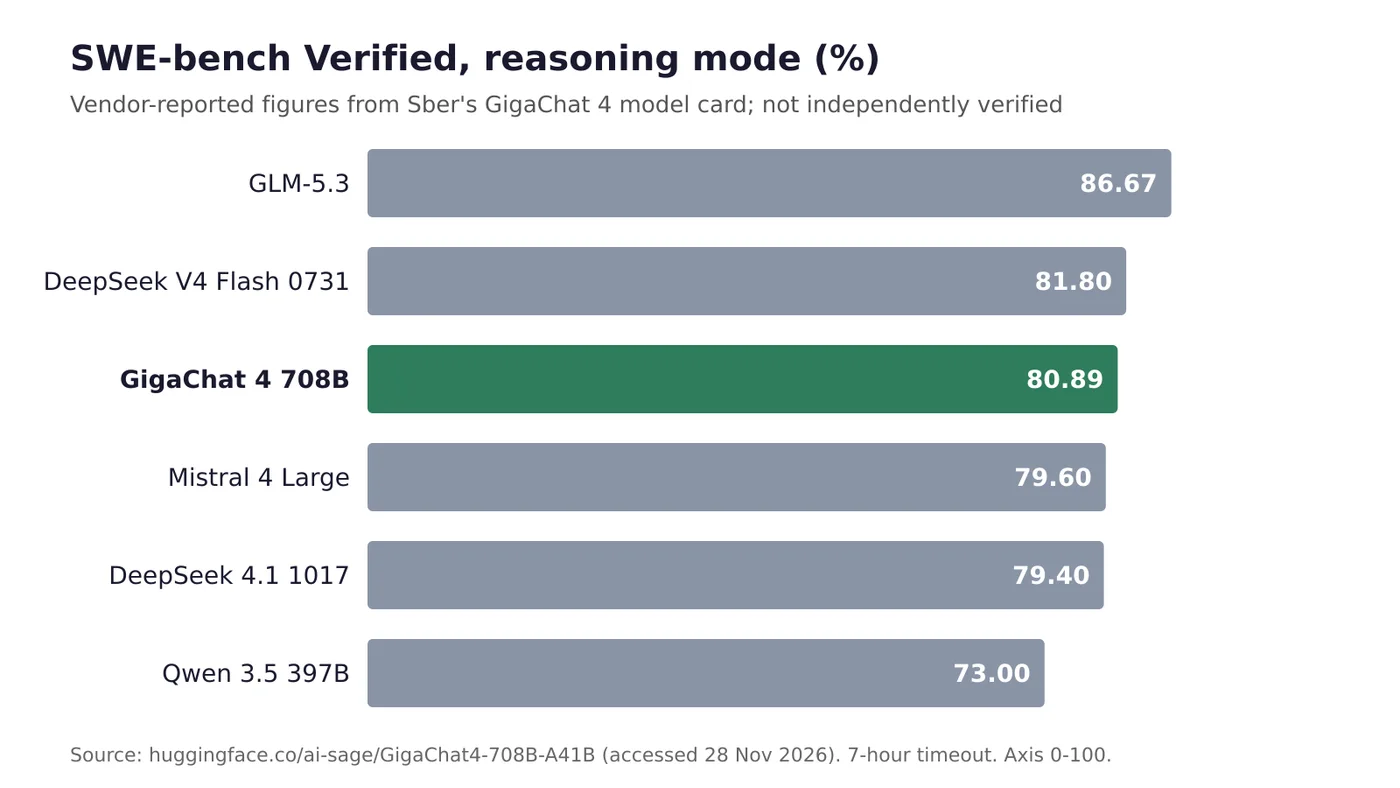
Sber's own tables tell a mixed story. GigaChat 4 leads this group on tool calling (BFCL v4) and τ²-Bench, and Sber reports strong instruction-following scores. It trails clearly on hard reasoning and knowledge tests such as GPQA Diamond and Humanity's Last Exam, and on Terminal-Bench 2.1. The card also lists a separate "DeepSeek V4 Flash 0731" score of 81.80 on SWE-bench Verified, slightly above GigaChat 4.
TrustTheBench does not yet track GigaChat 4, and it has no independent intelligence-index score yet. Sber has not published API pricing for the new model in the material we read.
Why it matters
GigaChat 4 is one of the largest open-weight models under a fully permissive licence. It is also one of the few frontier-scale open releases from outside the US and China. Its use of linear attention plus sparse attention reflects a wider push to make million-token contexts affordable to run. Sber's decision to publish intermediate checkpoints and a base model gives researchers more to study than a single finished model.
The split licensing matters for anyone who wants to build on it. The large model is MIT-licensed, while the small one that fits on a single GPU is restricted to non-commercial personal use. i10x.ai also advises teams with vendor or sanctions-screening duties to run the model through those checks before production use.
What we do not know yet
- How the models score on independent leaderboards such as Artificial Analysis or LMArena.
- Hosted API pricing and availability outside Sber's own GigaChat service.
- Exactly which hardware the model was trained on. The blog mentions only "thousands" of GPUs working together.
- When the promised technical report for the 37B model will appear.
Related news
- 26 November 2026: Tencent open-sourced DFly2, a speculative-decoding drafter for sparse-attention models such as DeepSeek V4.1 Flash. It addresses the same speed problem as GigaChat 4's DFlash2 drafter. (GitHub)
- 26 November 2026: Nvidia added a DFlash2 speculator to Nemotron 3.5 Parse, the same drafter family GigaChat 4 ships with. (Hugging Face)
- 23 November 2026: Z.ai released GLM-5.4, a 750-billion-parameter open model built on a loop transformer. It is a direct size-class rival to GigaChat 4's 708B flagship. (The Decoder)
Questions and answers
Is GigaChat 4 an official release?
Yes. Sber's GigaChat team announced it on its own blog on 26 November 2026 and published the weights on Hugging Face under the ai-sage account, with a technical report on GitHub. The benchmark numbers, however, are Sber's own.
Can I use GigaChat 4 commercially?
The 708B flagship is released under the MIT licence, which allows commercial use. The smaller 37B model uses a separate licence that i10x.ai describes as non-commercial and for individuals only, ruling out companies, universities and government bodies. Read the licence on each model card before building on either.
Is GigaChat 4 better than DeepSeek or GLM?
Not across the board, going by Sber's own tables. It beats GLM-5.3 and DeepSeek 4.1 1017 on tool calling (BFCL v4) and τ²-Bench. It trails them clearly on GPQA Diamond, Humanity's Last Exam and Terminal-Bench 2.1. On SWE-bench Verified it scores 80.89, against 86.67 for GLM-5.3 and 79.40 for DeepSeek 4.1 1017. No independent results exist yet.
What hardware do I need to run the 708B model?
Sber's documented FP8 setup uses two nodes with eight Nvidia H100 80GB GPUs each, 16 GPUs in total. i10x.ai reports that the 37B model fits on a single H100. GGUF versions are also published for other runtimes.
How long a context does it support?
Both models support up to 1,048,576 tokens, about one million. Sber says the window was extended step by step from 32K to 128K and then to the full million during training.
What are instant and reasoning modes?
Both modes live in the same checkpoint. Instant mode answers directly, while reasoning mode thinks step by step first. You choose per request, so you do not have to deploy two separate models. Scores in Sber's tables differ a lot between the modes, so check which mode a figure refers to.
How much does GigaChat 4 cost through an API?
The announcement and model cards we read do not give API prices. Because the weights are open, you can host the model yourself, at the cost of significant GPU hardware.
What happens next?
Sber says a separate technical report for the 37B model is planned. Independent benchmarkers such as Artificial Analysis have not yet listed GigaChat 4, and their results will show whether Sber's figures hold up.
Sources
- GigaChat 4Sber GigaChat team26 Nov 2026Official Checked
- GigaChat 4 (708B-A41B) model cardHugging Face / ai-sage27 Nov 2026Official Checked
- GigaChat 4 37B-A4B model cardHugging Face / ai-sage27 Nov 2026Official Checked
- GigaChat 4 Open Weights: The 708B Model Is MIT, the Small 37B Is Noti10x.ai27 Nov 2026 Checked
- GigaChat 4 708B-A41B: MIT open weightsexplainx.ai27 Nov 2026 Checked
- AngelSpec (DFly2) repositoryTencent26 Nov 2026 Checked
- Building on Nemotron 3.5 Parse: Open Data, Fine-Tuning, and Faster InferenceNvidia / Hugging Face26 Nov 2026 Checked
- Z.ai follows OpenAI into loop transformer territory with its new 750B flagship modelThe Decoder23 Nov 2026 Checked
Found this useful?
Send it to someone who follows this space.
This article was drafted with AI from the sources listed above and approved by an editor before publishing. Spotted a mistake? Tell us